

Walking through a Spanish-speaking art museum becomes much more exciting when you actually understand words like pintura, lienzo, and escultura! I’ve found that art vocabulary is also one of the easiest ways to make language learning more interesting because every word connects to something visual.
Learning the right Spanish art vocabulary helps you describe paintings, discuss techniques, understand museum signs, and even talk about your own creative work.
In this guide, you’ll learn 50 useful Spanish art words organized into practical categories, along with pronunciation help, examples, common mistakes, and cultural notes so you can start talking about art naturally. AI language apps are great for practicing pronunciation, and Babbel also covers culture-based vocabulary like this.
Quick List of 50 Essential Spanish Art Vocabulary Words
If you’re building your basic Spanish art vocabulary, start with the words you’ll actually hear in galleries, museums, art classes, and conversations. This quick reference covers useful Spanish art terms, from materials and techniques to movements and places, with simple pronunciation help.
| Spanish | English | Pronunciation |
|---|---|---|
| el arte | art | el AR-teh |
| el artista / la artista | artist | el ar-TEES-tah / la ar-TEES-tah |
| la pintura | painting / paint | la peen-TOO-rah |
| el cuadro | painting / picture | el KWAH-droh |
| el dibujo | drawing | el dee-BOO-hoh |
| la escultura | sculpture | la es-kool-TOO-rah |
| el retrato | portrait | el reh-TRAH-toh |
| el paisaje | landscape | el pie-SAH-heh |
| el boceto | sketch | el boh-SEH-toh |
| el lienzo | canvas | el lee-EN-soh |
| el pincel | paintbrush | el peen-SEL |
| la paleta | palette | la pah-LEH-tah |
| la pintura al óleo | oil paint / oil painting | peen-TOO-rah al OH-leh-oh |
| la acuarela | watercolor | la ah-kwah-REH-lah |
| el lápiz | pencil | el LAH-pees |
| el carboncillo | charcoal | el kar-bohn-SEE-yoh |
| la tinta | ink | la TEEN-tah |
| el color | color | el koh-LOR |
| el tono | tone | el TOH-noh |
| la sombra | shadow | la SOM-brah |
| la luz | light | la LOOS |
| la línea | line | la LEE-neh-ah |
| la forma | shape / form | la FOR-mah |
| la textura | texture | la teks-TOO-rah |
| la perspectiva | perspective | la pehrs-pek-TEE-vah |
| la composición | composition | la kohm-poh-see-SYON |
| el contraste | contrast | el kohn-TRAHS-teh |
| el fondo | background | el FON-doh |
| el primer plano | foreground | el pree-MEHR PLAH-noh |
| la técnica | technique | la TEK-nee-kah |
| pintar | to paint | peen-TAR |
| dibujar | to draw | dee-boo-HAR |
| esculpir | to sculpt | es-kool-PEER |
| crear | to create | kreh-AR |
| diseñar | to design | dee-seh-NYAR |
| mezclar | to mix | mes-KLAR |
| exponer | to exhibit | eks-poh-NEHR |
| la obra de arte | artwork | la OH-brah deh AR-teh |
| la obra maestra | masterpiece | la OH-brah mah-EHS-trah |
| la exposición | exhibition | la eks-poh-see-SYON |
| la galería | gallery | la gah-leh-REE-ah |
| el museo | museum | el moo-SEH-oh |
| el estilo | style | el es-TEE-loh |
| el realismo | realism | el reh-ah-LEES-moh |
| el surrealismo | surrealism | el soo-reh-ah-LEES-moh |
| el impresionismo | impressionism | el eem-preh-syoh-NEES-moh |
| el arte abstracto | abstract art | el AR-teh ahb-STRAHK-toh |
| el arte contemporáneo | contemporary art | el AR-teh kohn-tem-poh-RAH-neh-oh |
| el mural | mural | el moo-RAL |
| la fotografía | photography | la foh-toh-grah-FEE-ah |
These art words in Spanish give you a solid base whether you’re describing a painting, visiting a museum, or studying Spanish vocabulary for artists. Keep this list handy—the Spanish art words with English meanings become much easier once you start spotting them in real situations.
Spanish Words for Paintings, Drawings, and Types of Artwork
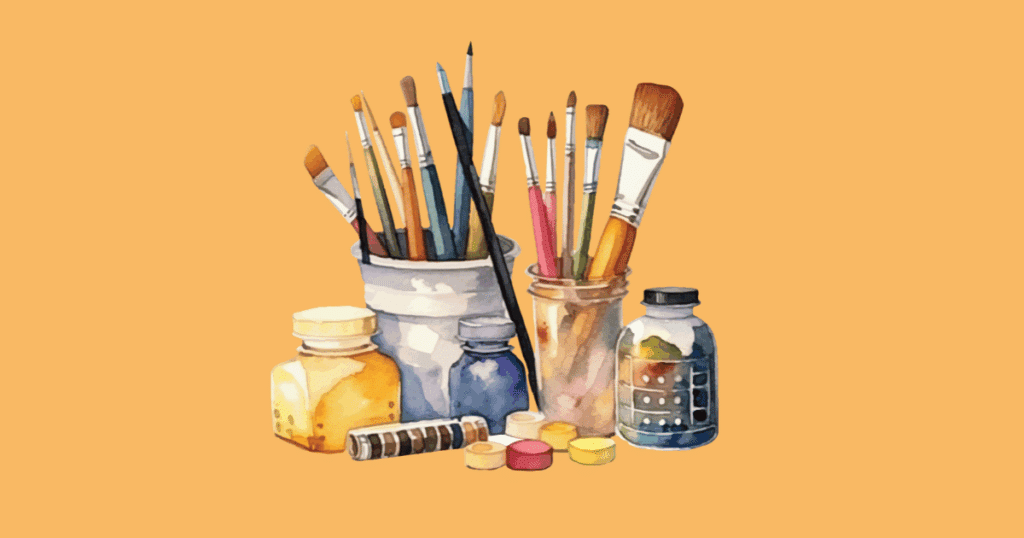
Walking through a Spanish-speaking art gallery gets easier once you know how different artworks are named. These are the art words I’d learn first because you’ll actually see them on museum signs, gallery labels, and class notes.
| Spanish | English | Pronunciation |
|---|---|---|
| la pintura | painting / paint | peen-TOO-rah |
| el cuadro | painting / picture | KWAH-droh |
| el dibujo | drawing | dee-BOO-hoh |
| el retrato | portrait | reh-TRAH-toh |
| el autorretrato | self-portrait | ow-toh-reh-TRAH-toh |
| el paisaje | landscape | pie-SAH-heh |
| el bodegón | still life | boh-deh-GON |
| la naturaleza muerta | still life | nah-too-rah-LEH-sah MWEHR-tah |
| el mural | mural | moo-RAL |
| la fotografía | photography | foh-toh-grah-FEE-ah |
| la obra de arte | artwork | OH-brah deh AR-teh |
For painting in Spanish, pintura is slightly tricky because it can mean both “paint” and “painting.” Context usually makes it obvious.
If you’re learning drawing in Spanish, portrait in Spanish, landscape in Spanish, or artwork in Spanish, memorize the article too.
Example: Este cuadro es un retrato de la artista. — “This painting is a portrait of the artist.”
Honestly, cuadro confused me at first, but you’ll hear it constantly around art.
Spanish Art Supplies and Materials Every Artist Should Know
Picture yourself walking into an art shop in Madrid or Mexico City, trying to explain exactly what you need. Knowing these basic supplies makes that conversation way easier, especially when you’re actually creating something.
| Spanish | English | Pronunciation |
|---|---|---|
| el lienzo | canvas | LYEHN-soh |
| el pincel | brush | peen-SEL |
| la paleta | palette | pah-LEH-tah |
| el lápiz | pencil | LAH-pees |
| el carboncillo | charcoal | kar-bohn-SEE-yoh |
| la tinta | ink | TEEN-tah |
| la acuarela | watercolor | ah-kwah-REH-lah |
| la pintura al óleo | oil paint | peen-TOO-rah al OH-leh-oh |
| la pintura acrílica | acrylic paint | peen-TOO-rah ah-KREE-lee-kah |
| la arcilla | clay | ar-SEE-yah |
| el caballete | easel | kah-bah-YEH-teh |
So, paintbrush in Spanish is pincel, while canvas in Spanish is lienzo. Palette in Spanish is paleta, pencil in Spanish is lápiz, and charcoal in Spanish is carboncillo.
Necesito un pincel más pequeño. — “I need a smaller brush.”
You’ll often hear óleo when people discuss traditional oil paintings. My memory trick: think “oily óleo.” Weird, but honestly, it sticks.
Spanish Words for Color, Composition, and Visual Elements
When you stand in front of a painting, these are the words that help you describe what your eyes actually notice. Learning this color vocabulary Spanish learners use also makes museum conversations feel way less intimidating.
| Spanish | English | Pronunciation |
|---|---|---|
| el color | color | koh-LOR |
| el tono | tone / shade | TOH-noh |
| la luz | light | LOOS |
| la sombra | shadow | SOM-brah |
| la línea | line | LEE-neh-ah |
| la forma | form / shape | FOR-mah |
| la textura | texture | teks-TOO-rah |
| la perspectiva | perspective | pehrs-pek-TEE-vah |
| la composición | composition | kohm-poh-see-SYON |
| el contraste | contrast | kohn-TRAHS-teh |
| el fondo | background | FON-doh |
| el primer plano | foreground | pree-MEHR PLAH-noh |
Composition in Spanish is composición, while perspective in Spanish is perspectiva. Texture in Spanish is textura—nice and easy because it looks familiar.
El artista utiliza mucho contraste entre la luz y la sombra. — “The artist uses a lot of contrast between light and shadow.”
One common mistake: sombra means shadow or shade, not simply “dark.” Once you start spotting luz, tono, and contraste together, describing artwork gets much easier.
Spanish Verbs for Painting, Drawing, and Creating Art
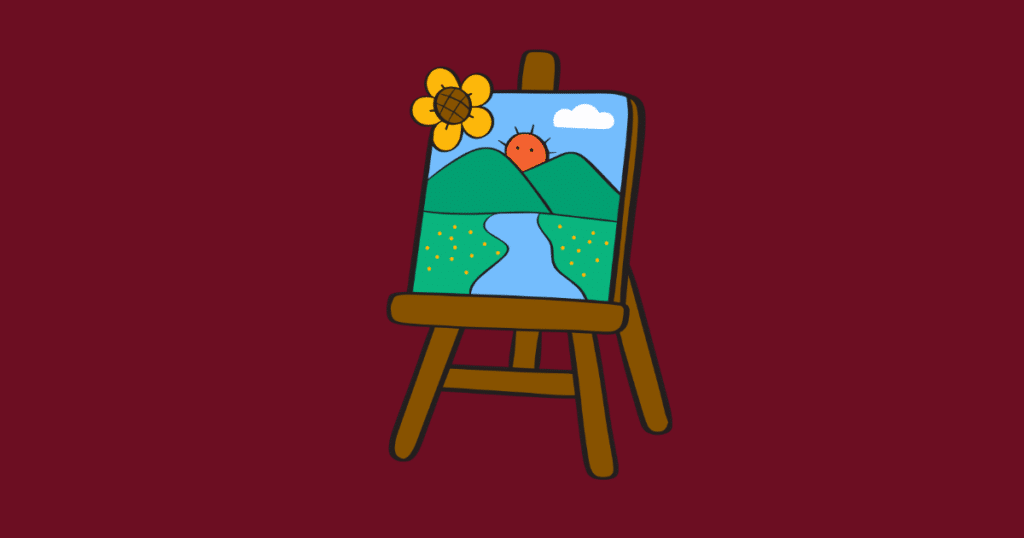
Art vocabulary gets much more useful once you can explain what an artist actually does. These verbs are handy in art classes, galleries, or even when you’re describing your own creative process.
| Spanish | English | Pronunciation |
|---|---|---|
| pintar | to paint | peen-TAR |
| dibujar | to draw | dee-boo-HAR |
| esculpir | to sculpt | es-kool-PEER |
| crear | to create | kreh-AR |
| diseñar | to design | dee-seh-NYAR |
| mezclar | to mix | mes-KLAR |
| colorear | to color | koh-loh-reh-AR |
| representar | to represent / depict | reh-preh-sen-TAR |
| exponer | to exhibit | eks-poh-NEHR |
| inspirarse | to be inspired | een-spee-RAR-seh |
To paint in Spanish is pintar, to draw in Spanish is dibujar, and to create in Spanish is crear. My Spanish teacher drilled these into me using short sentences, and honestly, that works better than memorizing verbs alone.
- Pinto paisajes. — “I paint landscapes.”
- Ella dibuja retratos. — “She draws portraits.”
- El artista creó esta obra en 2020. — “The artist created this work in 2020.”
One common mistake is forgetting that inspirarse is reflexive: Me inspiro en la naturaleza. Learn the verbs inside real phrases and they stick much faster.
Spanish Vocabulary for Art Styles and Movements

Art museums get more interesting once you can recognize the names of different styles. These art movements in Spanish are especially useful when reading gallery labels or talking about why one painting looks completely different from another.
| Spanish | English | Pronunciation |
|---|---|---|
| el realismo | realism | reh-ah-LEES-moh |
| el surrealismo | surrealism | soo-reh-ah-LEES-moh |
| el impresionismo | impressionism | eem-preh-syoh-NEES-moh |
| el cubismo | cubism | koo-BEES-moh |
| el expresionismo | expressionism | eks-preh-syoh-NEES-moh |
| el arte abstracto | abstract art | AR-teh ahb-STRAHK-toh |
| el arte moderno | modern art | AR-teh moh-DEHR-noh |
| el arte contemporáneo | contemporary art | AR-teh kohn-tem-poh-RAH-neh-oh |
| el arte clásico | classical art | AR-teh KLAH-see-koh |
| el arte urbano | street / urban art | AR-teh oor-BAH-noh |
Abstract art in Spanish is arte abstracto, while surrealism in Spanish is surrealismo.
You’ll also hear adjective forms like surrealista, abstracto/abstracta, and contemporáneo/contemporánea. They change when needed to match the noun.
Picasso es famoso por su relación con el cubismo. — “Picasso is famous for his connection with Cubism.”
Memory trick: movements ending in -ismo often match English words ending in “-ism.” Easy win.
Spanish Museum and Art Gallery Vocabulary
Walking into a museum abroad is much easier when you know the words on signs, tickets, and gallery maps. This museum vocabulary Spanish learners need is especially useful when you’re traveling and don’t want to rely on your phone every five minutes.
| Spanish | English | Pronunciation |
|---|---|---|
| el museo | museum | moo-SEH-oh |
| la galería | gallery | gah-leh-REE-ah |
| la exposición | exhibition | eks-poh-see-SYON |
| la colección | collection | koh-lek-see-ON |
| la obra maestra | masterpiece | OH-brah mah-EHS-trah |
| el museo de arte | art museum | moo-SEH-oh deh AR-teh |
| la entrada | entrance / ticket | en-TRAH-dah |
| la sala | gallery room | SAH-lah |
| el guía / la guía | guide | GHEE-ah |
| el catálogo | catalogue | kah-TAH-loh-goh |
Art gallery in Spanish is galería, while exhibition in Spanish is exposición. In casual conversations, you may also hear expo as a shortened form.
¿Dónde está la exposición de arte moderno? — “Where is the modern art exhibition?”
Honestly, learn entrada early too—it’s one of those small travel words you’ll use everywhere.
How to Pronounce Spanish Art Vocabulary Correctly
Spanish art pronunciation gets much easier when you stop worrying about perfect accents and focus on a few repeating sound patterns. Honestly, Spanish pronunciation practice helped me more once I started saying whole words aloud instead of studying rules separately.
- arte — AR-teh
- pintura — peen-TOO-rah
- dibujo — dee-BOO-hoh
- lienzo — roughly LYEN-soh in much of Latin America
- composición — kohm-poh-see-SYON
- exposición — eks-poh-see-SYON
- fotografía — foh-toh-grah-FEE-ah
Wondering how to pronounce pintura? Put the stress on TOO: peen-TOO-rah.
Spanish j normally has a breathy sound similar to English “h,” which explains dibujo. The Spanish r may be lightly tapped or strongly rolled depending on its position.
Pronunciation also changes by region. For example, some sounds differ between Spain and Latin America, but neither version is more “correct.”
My shortcut: copy native rhythm first, then polish individual sounds later. It feels more natural fast.
Example Sentences Using Spanish Art Vocabulary
The fastest way to make Spanish art sentences stick is to use vocabulary inside real thoughts. These examples are useful when talking about art in Spanish at a museum, gallery, or art class.
- Me gusta mucho esta pintura. — I really like this painting.
- ¿Quién pintó este cuadro? — Who painted this painting?
- El artista utiliza colores muy vivos. — The artist uses very vivid colors.
- Estoy aprendiendo a dibujar retratos. — I’m learning to draw portraits.
- Esta obra tiene una composición interesante. — This artwork has an interesting composition.
- Visitamos una exposición de arte contemporáneo. — We visited a contemporary art exhibition.
- La escultura está hecha de piedra. — The sculpture is made of stone.
If you want to describe a painting in Spanish, don’t memorize every sentence exactly. Swap words like pintura, retrato, colores, or escultura to create your own versions, and use the Instituto Cervantes Spanish learning resources for more structured vocabulary practice.
Honestly, that little substitution trick makes vocabulary feel usable much faster.tly. Swap words like pintura, retrato, colores, or escultura to make your own versions. Honestly, that little substitution trick makes vocabulary feel usable much faster.
Common Spanish Art Vocabulary Mistakes English Speakers Make
Spanish art vocabulary mistakes are usually small, but they can make your Spanish sound less natural. Honestly, a few of these caught me out for ages.
- Say el arte, not la arte; in singular, arte is normally masculine, as explained by the Real Academia Española.
- Don’t pronounce arte exactly like English “art.” Say AR-teh.
- “Picture” isn’t always pintura. Depending on context, use foto, imagen, or cuadro.
- Dibujo means drawing, while diseño means design.
- Use artista for an artist generally; pintor/pintora specifically means painter.
- Match adjectives correctly: arte abstracto but pintura abstracta.
- In dibujo, the Spanish j sounds roughly like an English “h.”
- Watch for Spanish false friends art learners meet, and avoid translating artistic expressions word-for-word.
Learning whole phrases instead of isolated translations fixes most of these mistakes surprisingly fast.s most of these mistakes surprisingly fast.
Easy Ways to Memorize Spanish Art Words Faster
The easiest way to learn Spanish art vocabulary is to connect words with things you can see and use. Honestly, five words practiced beat fifty words crammed once.
- Label brushes, pencils, and canvases in Spanish.
- Make Spanish art flashcards with pictures instead of translations.
- Group words by materials, styles, verbs, and museums.
- Describe one painting in Spanish each day.
- Practice five words at a time.
- Pair nouns with verbs: pintar + cuadro, dibujar + retrato, crear + obra.
- Follow museum accounts.
- Use spaced repetition.
- Say words aloud.
- Build sentences.
These habits help you memorize Spanish vocabulary faster without making practice feel like homework.
Conclusion
You now have 50 essential Spanish art vocabulary words covering paintings, materials, artistic techniques, museums, movements, and everyday conversations about art.
Rather than trying to memorize the entire list at once, choose five to ten words and use them to describe a painting, photograph, or artwork you already like. Saying the words aloud and putting them into your own sentences will make them much easier to remember.
