

Hey there, welcome to our best language learning apps review of 2026!
We tested 12 of the most popular language learning apps out there, putting each one through real lessons across three languages for key features like curriculum structure, speaking practice, pricing, and how well the app actually got words to stick.
These 7 came out far ahead of the rest.
Whether you’re chasing fluency in a second language for travel, work, or family, or you already have a specific language locked in and just need the right course to get there, this guide will help you find the best fit fast.
The last thing you want to do is pay for a year of Premium and quit by week three because the lessons feel like busywork.
Choosing one of these 7 best language learning app means you’re learning with a method that’s actually built to make things stick, and your money goes toward real progress instead of gamified filler.
Ready to actually start speaking with real confidence instead of just collecting a streak badge?
Keep reading.
What are the Best Language Learning apps?
If you’re in a hurry and just want the quick answer to which language course is right for you, here’s our brief overview:
- Babbel – Best language learning app
- Rocket Languages – Best for structured, in-depth courses
- Mondly – Best value for money
- Rosetta Stone – Best for immersive learning
- Pimsleur – Best for speaking and pronunciation
Don’t worry, Lingopie and Lingoda aren’t left out — they get their full spotlight in the detailed reviews below. Whichever language learning app you end up landing on, all seven made this list for a real reason.
1. Babbel
Best language learning app overall
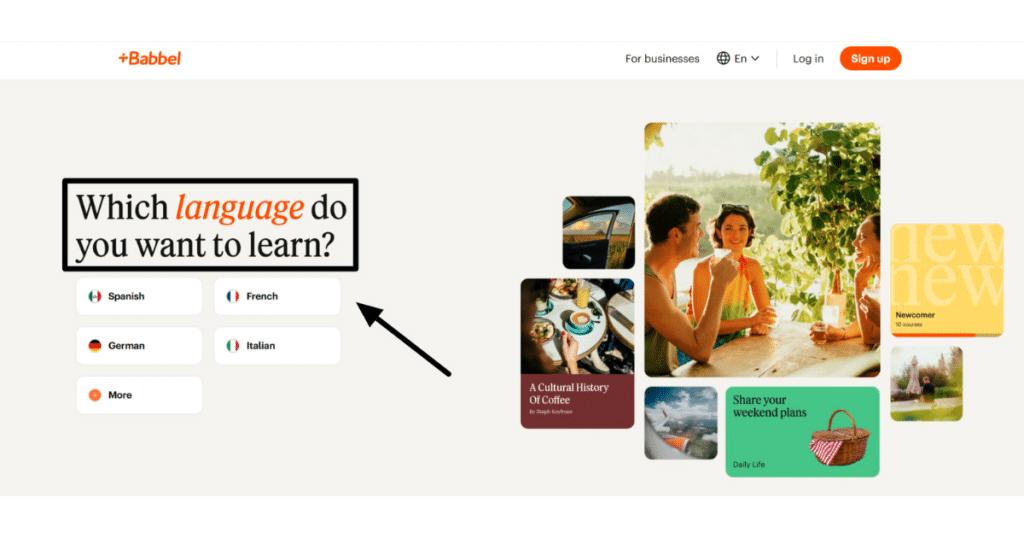
Key Features:
- 13-14 languages, lessons built by real language teachers
- 10-15 minute lessons focused on practical, everyday vocabulary and grammar
- Built-in speech recognition in every lesson
- Pricing: roughly $8-15/month with typical discounts, or a lifetime plan ($299) covering all languages
Pros:
- Bite-sized lessons that actually fit into a lunch break
- Grammar is explained clearly instead of just thrown at you
- Speech recognition forces you to actually talk, not just tap
- Lifetime plan covers every language, so switching later doesn’t cost you again
Cons:
- Full price ($18/month before discounts)
- No live human tutoring built in
Overview:
Babbel is the best language learning app I point total beginners toward first, no contest. It’s not flashy. It’s not trying to be a game. It’s just a well-built, structured language course made by actual teachers, and that shows the second you open your first lesson. It’s for the person who wants real progress on real conversations — ordering food, small talk, asking directions — without needing a grammar degree to get there.
Review:
Here’s the thing that makes Babbel different from a lot of the “fun” apps: the lessons build on each other. Lesson 12 assumes you actually learned lesson 11.
That sounds obvious, but a shocking number of language apps just throw random vocab at you and hope something sticks. Unlike Duolingo’s free version, Babbel doesn’t let you stall out on ads and repetitive mistakes — every lesson is built by a real teacher, and grammar is explained in plain English, or whatever your native language happens to be, instead of leaving you to guess.
Compared to other language learning apps, Babbel goes deeper into grammar and real conversational phrasing instead of gamified word-matching.
We spent time in the Spanish and German courses specifically testing the speech recognition, and it genuinely made us slow down and fix our pronunciation instead of mumbling through. That’s a small thing, but it adds up over weeks.
See my detailed babbel review
Benefits :
- Real teachers built the curriculum, so lessons build logically instead of feeling random
- Short lessons mean you’ll actually stick with it on busy weeks
- Speech recognition keeps you honest about pronunciation
- Lifetime plan means switching to a different language later doesn’t cost you extra
Drawback: the sticker price looks scary until you notice they’re basically always running a sale.
If you’re brand new to a language and want a program that respects your time and actually explains what’s going on grammatically, Babbel is the safe, smart first pick — it’s the language learning app we recommend most often to total beginners.
2. Rocket Languages
Best app for Structured, In-Depth Courses
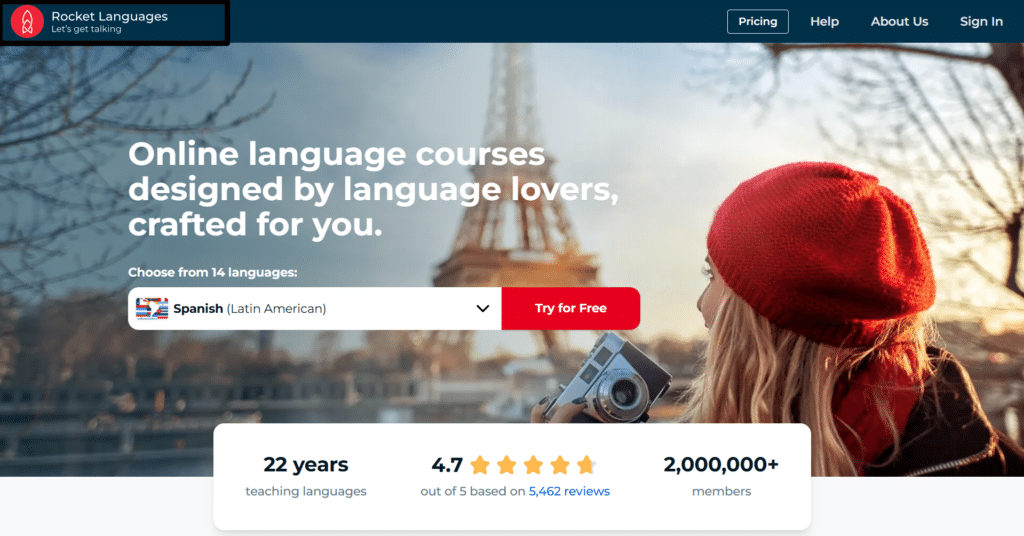
Key features:
- One-time payment model — no recurring subscription, ever
- Pricing: $150 to $450 for different levels
- Rocket Record speech recognition compares your pronunciation to native speakers
- 14+ languages, including American Sign Language
- 60-day money-back guarantee
Pros:
- Pay once, own it forever — no monthly bill creeping up on you
- Speaking-first approach means you’re saying full sentences early, not just memorizing words
- Deep, structured content — genuinely more comprehensive than most subscription apps
Cons:
- Upfront cost is a real chunk of money at once
- Drills can feel repetitive if you crave variety
Overview:
Rocket Languages is for the learner who’s done dabbling and actually wants to get somewhere. It’s the language learning app for people who are done paying subscriptions forever. Instead of a monthly subscription that nickel-and-dimes you forever, you buy a level (or all three) once and it’s yours for life. It leans hard into speaking and real dialogue instead of gamified vocabulary matching, which makes it feel more like a full language course and less like a mobile game.
Review:
The reason this earns “best structured course” is the Rocket Reinforcement system — every lesson loops back with flashcards, quizzes, and review drills until the material actually locks in, instead of moving on and hoping you remembered it.
Positioned against Babbel or Mondly, Rocket costs a lot more upfront, but the math flips if you stick with a language for more than a year or two — you stop paying entirely while subscription apps keep billing you every month.
The all-three-levels bundle at $259.90 is genuinely the best value on the list if you’re committed — that’s roughly the price of two levels for three.
Benefits :
- Lifetime access means the cost stops the moment you stop paying, not before
- Speaking-first structure builds real conversational confidence, not just vocabulary
- 60-day guarantee makes it close to risk-free to try
- Deep content — over 150 lessons in the full bundle
Drawback: it’s not gamified or bite-sized, so if you want a quick dopamine hit from a streak counter, look elsewhere.
If you’re serious about actually speaking the language with confidence, not just recognizing words on a screen, and you hate the idea of paying forever, Rocket Languages’ one-time price and depth make it one of the smartest long-term investments on this list.
3. Mondly
Best Value for Money
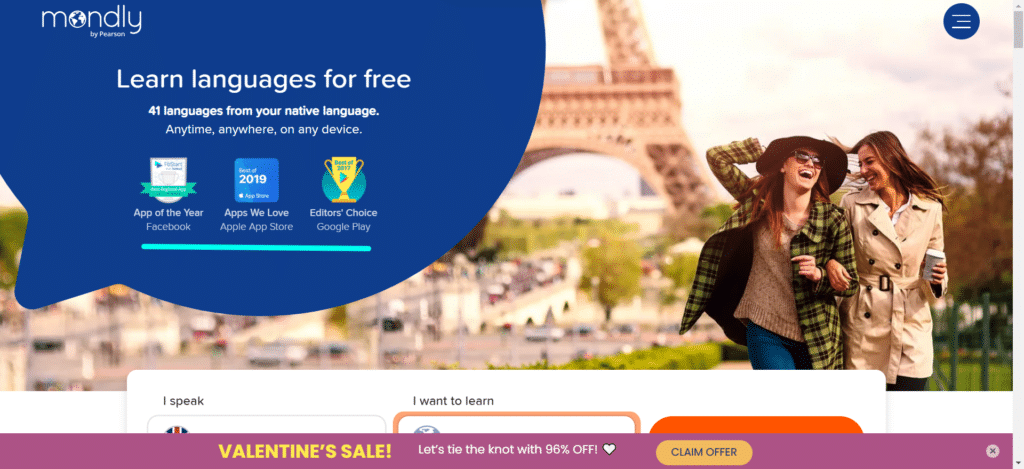
Key features:
- 41 languages, all included in every subscription tier
- Short 5-10 minute Daily Lessons plus scenario-based chatbot conversations
- AR and VR modes for immersive practice (VR requires a headset)
- Pricing: roughly $10-13/month, ~$62/year annual, or a lifetime plan around $80-130
Pros:
- Cheapest way to get access to dozens of languages under one price
- Daily Lesson habit-loop keeps the learning experience quick and motivating
- Backed by Pearson, so there’s real institutional weight behind it
Cons:
- Chatbot “conversations” are scripted multiple-choice trees, not real back-and-forth
- Grammar explanations are thin — don’t expect deep breakdowns
- Progress plateaus around an early-intermediate level
Overview:
Mondly is the budget-friendly, quick-hit option, and it knows it. This app offers all 41 languages under one subscription instead of billing you per language, and the Daily Lesson feature is built to be a two-minute habit you barely have to think about starting.
Review :
The value math here is hard to argue with. For about what Babbel or Rosetta Stone charge for one language, Mondly gives you every language it offers. That matters if you’re a “learn a little of everything” type or just haven’t committed to one language yet.
Where it loses points against Rocket Languages or Lingoda is depth — the “conversations” are really pick-a-response menus dressed up to feel interactive, not open-ended practice.
We ran the Daily Lesson feature for several weeks across two languages, and the habit-forming design works — it’s genuinely easy to knock one out with morning coffee. Mondly’s Daily Lessons help you learn language basics in small, bite-sized chunks, but don’t expect it to carry you to fluency alone.
Benefits :
- Best price-per-language on this entire list, by a wide margin
- Daily Lesson habit loop is low-friction and easy to stick with
- Backed by Pearson, a legitimate education company
- Lifetime deal is one of the cheapest ways to lock in language access for good
Drawback: treat it as a fun daily supplement, not your only tool, if you want to hold a real conversation.
If budget is the deciding factor and you want a low-pressure way to build a daily habit across dozens of languages, Mondly is the easiest yes on this list.
4. Rosetta Stone
Best for Immersive Learning
Key features:
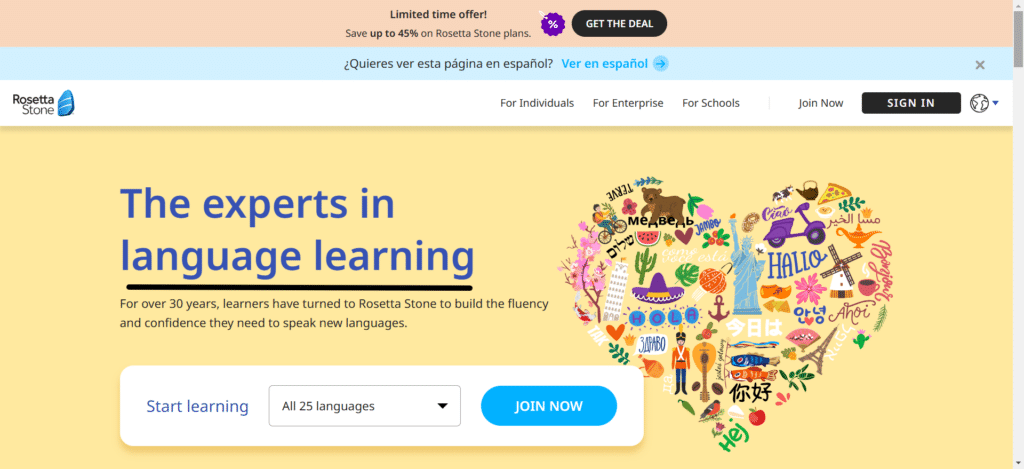
- 25+ languages using “Dynamic Immersion” — no translations, just images, audio, and context
- TruAccent speech recognition for pronunciation feedback
- Pricing: 1-month plan ~$20, 12-month ~$160/year,
- 30-day money-back guarantee, 3-day free trial
Pros:
- Learning without translation genuinely trains you to think in the language, not just decode it
- TruAccent gives real-time pronunciation feedback that’s noticeably accurate
- Lifetime plan covers every language for one price
Cons:
- Minimal grammar explanation — you’re often left to infer rules on your own
- No open-ended conversation practice, just scripted “Milestone” dialogues
Overview:
Rosetta Stone has been around since before smartphones existed, and its whole philosophy hasn’t changed: you learn the way a kid does, through immersion and context, never through direct translation. It’s the most old-school name on this list, and in some ways that’s exactly the point.
Review :
The immersion method is proof-positive when you actually sit through it — you’re shown an image, hear the word or phrase, and have to connect the two without ever seeing an English translation. You’re never translating in your head; you just start thinking directly in your target language. It’s uncomfortable at first and then, surprisingly, it clicks.
Compared to Babbel, Rosetta Stone is pricier and slower to explain grammar rules, but the immersive style builds a different kind of instinct for the language. Compared to Pimsleur’s audio-only approach, Rosetta Stone adds visuals and reading, which helps if you’re not a pure auditory learner.
We tested the TruAccent tool across a handful of Spanish and French sessions, and it caught pronunciation slips that other apps’ speech tools missed entirely — it’s genuinely one of the better pronunciation engines out there.
Benefits :
- Immersion method builds intuition, not just memorized translations
- TruAccent is one of the sharper pronunciation tools among these seven apps
- Lifetime plan covers 25+ languages for a single payment
- 30-day money-back guarantee removes most of the risk
Drawback: pair it with a grammar resource or another app if you want the “why” behind the rules explained outright.
If you want to build real intuition for a language instead of just memorizing translated phrases, and you don’t mind a slower ramp-up, Rosetta Stone’s immersion method is worth the investment.
5. Pimsleur
Best for Speaking practice and Pronunciation
Key features:
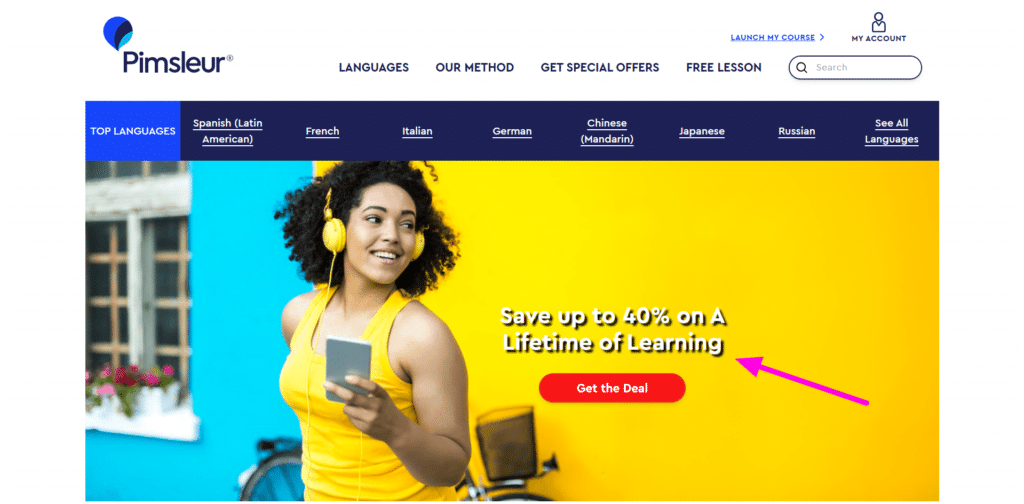
- Audio-only method built on “Graduated Interval Recall” — spaced repetition through listening and speaking
- Each lesson is exactly 30 minutes, hands-free, ideal for commutes or chores
- Pricing: Premium (~$20/month, one language) or All Access (~$21/month or ~$165/year, 50+ languages)
- Account sharing with up to 3 family members on some plans
Pros:
- Pronunciation and listening comprehension improve fast — this is the app’s whole superpower
- Fully hands-free, so it fits into a commute, a walk, or doing dishes
- Scientifically-designed spacing means vocabulary actually sticks in long-term memory
Cons:
- No reading or writing practice in the Classic version, and grammar isn’t explained directly
- Pricier than most competitors for what’s ultimately audio-only content
- No real two-way conversation — you’re responding to a recording, not a person
Overview:
Pimsleur is the one to reach for if your main goal is sounding good and understanding fast spoken language, not reading grammar charts. It’s less of a traditional language course and more of a listen-and-repeat drill system, built entirely around audio, which makes it the most “passive-friendly” app on this list — you genuinely can learn while driving.
Review :
The method is simple but rigorous: hear a phrase, repeat it, get quizzed on it again later at a carefully timed interval so it moves into long-term memory instead of leaking out after a day. It’s genuinely one of the best ways to learn pronunciation without ever opening a textbook. It sounds almost too basic, but the gains are real and noticeable within a few weeks.
Positioned against Rocket Languages, Pimsleur is more expensive per language and less visual, but it wins clearly on raw listening and speaking drill quality. Positioned against Babbel, it skips grammar explanation almost entirely in favor of pure repetition.
We ran the 30-minute daily lessons during commutes for several weeks, and the “no screen needed” format made it the single easiest app on this list to actually stick with consistently — there’s no excuse not to do a lesson when you’re already sitting in traffic anyway.
Benefits:
- Best-in-class for pronunciation and listening comprehension specifically
- Fully audio-based, so it works anywhere you can wear headphones
- Spaced repetition is backed by real learning science, not just marketing
- Family sharing on All Access brings the effective cost down if split
Drawback: pair it with a reading-focused app if you also want strong writing and grammar skills.
If your main goal is sounding confident and understanding native speakers at real speed, and you want something you can do without ever looking at a screen, Pimsleur is the strongest pick here.
6. Lingopie
Best for Learning Through TV & Movies
Key features:
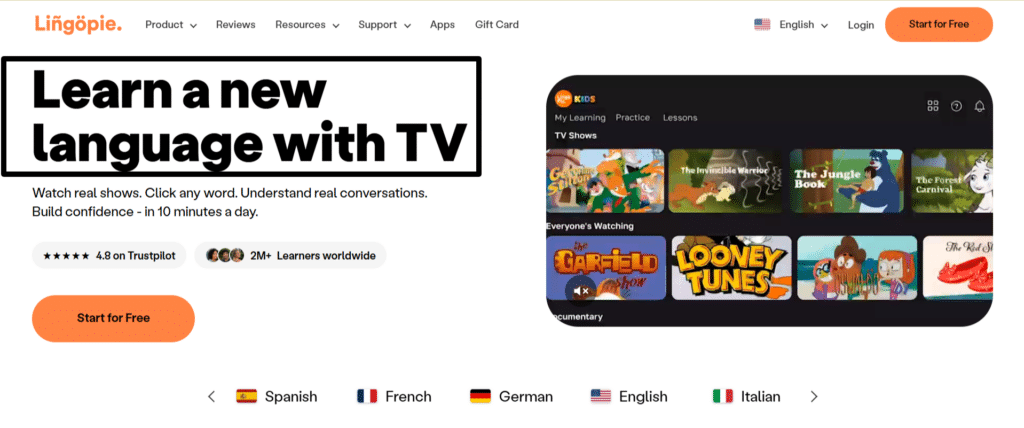
- Learn through a curated library of native-language TV shows, movies, and music videos (thousands of hours)
- Interactive dual subtitles — click any word for an instant translation and auto-saved flashcard
- New (April 2026) Chrome extension brings the same interactive subtitle tools to Netflix directly
- Pricing: roughly $12/month on a 3-month plan, or as low as $5.99/month on annual promos; lifetime option also available
- 12-15 languages, 7-day free trial
Pros:
- Genuinely doesn’t feel like studying — you’re just watching shows you’d want to watch anyway
- Context-based vocabulary sticks better than flashcard lists memorized in isolation
- New Chrome extension means you’re no longer limited to Lingopie’s own content library
Cons:
- Best suited to intermediate-to-advanced learners — true beginners may feel lost fast
- Occasional subtitle translation inaccuracies have been flagged by longtime users
- Limited to a smaller set of languages than apps like Mondly or Pimsleur
Overview:
Lingopie is for the person who already loves watching foreign shows and wants that screen time to double as language practice. It’s built entirely around real, entertaining media instead of scripted lesson dialogue, and it doesn’t make learning feel like homework the way literally any other app on this list can.
Review :
The clickable dual-subtitle system is the whole magic trick here — pause on a word mid-scene, get the translation and pronunciation instantly, and it’s automatically saved to a flashcard deck tied to that exact moment in the show. That context is what makes the vocabulary stick; you’re not memorizing “el gato” in a vacuum, you’re remembering the scene where the cat showed up. You end up learning new words the same way native speakers do — through context, not flashcard drills.
Compared to Rosetta Stone or Pimsleur, Lingopie skips structured lessons entirely in favor of pure immersion through entertainment, which works better for learners who already have some foundation and want to build real-world comprehension.
We spent time in the platform testing the Grammar Coach feature, which pops up in-context explanations for tricky phrases without yanking you out of the show entirely — a nice touch that most “watch and learn” competitors skip.
Benefits :
- Makes screen time productive instead of guilty pleasure
- Context-based flashcards from real scenes retain better than generic word lists
- New Netflix-compatible Chrome extension massively expands your content options
- Reasonably priced, especially on annual or lifetime deals
drawback: not the best starting point for absolute beginners — pair it with a structured app early on, then lean on Lingopie once you have a foundation.
If you already binge shows and want that time to start paying off in real language skills, Lingopie turns your Netflix habit into legitimate practice.
7. Lingoda
Best for Live Classes With Real Teachers
Key features:
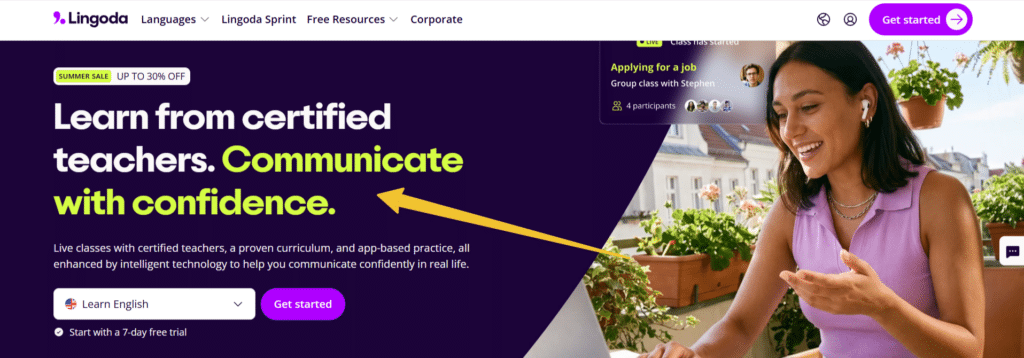
- Live, small-group or private video classes with certified native-speaking teachers, available 24/7
- Languages: English (including Business English), German, French, and Spanish
- Pricing: group classes as low as ~$9.50-10/class with volume plans, private classes ~$25-30/class
- “Sprint” challenge refunds up to 50-100% of your cost if you attend every class
- CEFR-aligned curriculum with certification upon completing a level
Pros:
- Real human teacher, real-time correction — nothing an app can fully replicate
- 24/7 class scheduling actually fits around odd work hours and time zones
- The Sprint refund program is a genuinely clever way to reward consistency
Cons:
- Meaningfully more expensive than any self-study app on this list
- Only four languages offered, so it won’t work for less common language goals
- Group class quality can vary depending on who else shows up that day
Overview:
Lingoda is the one app on this list that isn’t really an app at all — it’s live human instruction, delivered online, with actual certified teachers and a real curriculum behind it. It’s for the learner who’s past the “dabbling” stage and wants structured accountability with feedback from a person, not a speech-recognition algorithm.
Review :
One of Lingoda’s best features is the Sprint program: commit to a set number of classes over one or two months, and if you actually show up and complete them, Lingoda refunds a significant chunk of your money back — sometimes up to the full amount. That’s a rare, honest incentive structure in an industry full of subscriptions designed to be forgotten about, and it works especially well for language learners who tend to lose motivation without a deadline hanging over them.
Positioned against every other app here, Lingoda is by far the most expensive per hour of instruction, but it’s also the only one offering a real, live teacher correcting your mistakes in the moment. Positioned against a private tutor marketplace like italki, Lingoda costs more per class but guarantees certified teachers and a structured CEFR curriculum instead of leaving quality control up to you.
We sat in on both group and private sessions across two languages, and the 24/7 scheduling was the standout practical win — being able to book an early-morning or late-night class around a real schedule made it far easier to stay consistent than any fixed classroom time would’ve allowed.
Benefits:
- Real-time correction from certified native teachers, not an algorithm
- 24/7 scheduling fits around actual work and life commitments
- Sprint program can refund a large chunk of your money for consistency
- CEFR certification carries real weight for school or work purposes
Drawback: this is a premium price point — treat it as the “serious accountability” layer on top of a cheaper self-study app, not necessarily your only tool.
If you want the accountability and correction only a real teacher can give, and you’re ready to invest in live instruction, Lingoda is the strongest pick on this list — just budget for it accordingly.
Buying Guide:
We’ve included this buying guide because most people pick a language app for the wrong reason, and it costs them. Every app on this list takes a different approach to language learning, and that’s exactly why picking the most popular one instead of the right one is how people end up quitting. They chase the flashiest app, or the cheapest one, or whatever their friend used — and three months later they’ve quit, out $150, having barely learned “hola.”
The truth is, the “best” app depends entirely on two things: how you personally learn best, and what your actual goal is. Follow the steps below and you’ll land on the right pick the first time instead of app-hopping for a year.
How to Choose the Right Language App
Step 1: Get honest about your goal. This is the single biggest factor, and almost everyone skips it. “Learning Spanish” isn’t a goal — it’s a wish, and diving into a new language without a clear goal is how most people quit within a month. Are you trying to survive a two-week trip? Hold a real conversation with your in-laws? Pass a certification for work? Each of those needs a completely different app.
If your goal is travel survival, you need fast, practical phrases — Babbel or Mondly. If your goal is real conversational fluency, you need speaking practice and correction — Rocket Languages, Pimsleur, or Lingoda. If your goal is a formal certification for school or a job, you need Lingoda’s CEFR-based classes specifically, since none of the self-study apps issue recognized credentials.
Step 2: Match the app to your learning style. Some people learn by listening, some by seeing, some by doing. Lying to yourself here is how you end up paying for an app you never open.
If you learn best by ear — you remember songs better than spelling, you like podcasts — go audio-first with Pimsleur. If you’re a visual learner who needs to see a word to remember it, Rosetta Stone or Babbel will serve you better. If you learn best by total immersion in something entertaining, Lingopie’s show-and-movie method will actually hold your attention where a textbook-style app won’t.
Step 3: Figure out how much accountability you need. Be honest about your track record with self-directed goals. If you’ve got three unfinished workout apps and two abandoned journaling habits on your phone right now, a fully self-paced app is going to join that graveyard.
If you need a deadline and a real person expecting you to show up, Lingoda’s live classes (or its Sprint refund challenge, which pays you back for consistency) will keep you honest in a way no streak counter can. If you’re naturally disciplined and just want efficient content, any of the self-study apps will do.
Features That Actually Matter (and How They Affect Your Results)
Lesson length and format :This one’s bigger than people expect. Short lessons (Babbel and Mondly run 5-15 minutes) are easy to fit into a busy day, but they can feel choppy if you want to really sink into a language.
Longer, structured lessons (Pimsleur’s 30-minute audio sessions, Rocket Languages’ modules) demand more upfront commitment but build deeper retention per session.
If you’re a busy parent or have an unpredictable schedule, short lessons win — you’ll actually finish them.
If you have a consistent block of time (a commute, a lunch break), longer sessions get you further, faster.
Speech recognition quality: Nearly every app claims to have this now, but the quality varies a lot, and it directly affects how fast your pronunciation improves. Babbel, rosetta stone and Rocket Languages are both built specifically to compare you against native speaker audio and flag exact sounds you’re getting wrong — that’s a real skill-building tool.
Weaker recognition systems just check if you said “close enough” and move on, which won’t actually fix bad habits. If pronunciation is a priority (say, you’re moving abroad or need to be understood on the phone), prioritize apps with strong, specific pronunciation feedback over ones that just check a box.
Structured curriculum vs. flexible/scenario-based content The way these apps teach grammar and vocabulary varies enormously, from full immersion to explicit rule-by-rule breakdowns.
If you want deep, structured content, look for a language course built by real teachers rather than a purely gamified app. A tightly structured curriculum (Rocket Languages, babbe,Pimsleur) builds each lesson directly on the last one, so you’re never missing a foundational piece.
A looser, scenario-based app (Mondly’s topic map, Lingopie’s show library) lets you jump around based on interest, which is more fun but can leave gaps in your grammar. Beginners generally do better with structure — you don’t yet know what you don’t know. Intermediate-to-advanced learners can safely go looser, since they already have a foundation to fill in around.
Live human interaction vs. self-paced software This is the single biggest quality-of-experience difference on this whole list, so it gets its own head-to-head below.
Head to Head: Self-Paced Apps vs. Live Classes
Self-paced apps (Babbel, Rocket Languages, Mondly, Rosetta Stone, Pimsleur, Lingopie) These win on cost, flexibility, and total control over your schedule. You can do a lesson at 2 a.m. in your pajamas, pause mid-sentence, and repeat a tricky part twenty times without anyone judging you. The tradeoff is that even the best speech recognition can’t correct you the way a human can, and there’s no one holding you accountable if you skip a week (or a month).
Live classes (Lingoda) These win on real feedback, real conversation, and accountability. A certified teacher hears your specific mistakes and corrects them in real time — something no algorithm fully replicates yet. The tradeoff is cost (often 5-15x more per hour than a self-paced app) and a fixed schedule, even with Lingoda’s 24/7 booking flexibility.
Our honest take: if your budget allows it, the strongest combination is a self-paced app for daily practice (vocabulary, listening, grammar) paired with periodic live classes for conversation and correction. If you can only pick one, choose based on Step 3 above — pick live classes if you know you need accountability, and pick a self-paced app if you’re disciplined enough to actually open it every day on your own.
Conclusion
Okay, we covered a lot of ground — let’s bring it back home.
For most people just starting out to learn a language , we have to recommend Babbel. It’s structured by real teachers, the lessons are short enough that you’ll actually finish them, and the price stays reasonable even before a sale kicks in. If you’re not sure which app on this list is “you,” Babbel is the safest first step.
If you’re serious about actually holding a conversation and want to stop paying forever, Rocket Languages is the one to buy once and own for life.
And if budget genuinely isn’t the deciding factor and you want the fastest, most reliable path to real fluency, pair Lingoda’s live classes with a self-paced app like babbel for daily practice. Nothing on this list corrects your mistakes in real time the way an actual human teacher can — you’re basically buying yourself a personal tutor on demand, 24/7.
Honestly, though, you can’t go too wrong with any app on this list — they all made the cut for a reason. No matter where you are in your learning journey, the real mistake isn’t picking the “wrong” app, it’s picking one and never opening it.
Which one are you going with?
let me know.
